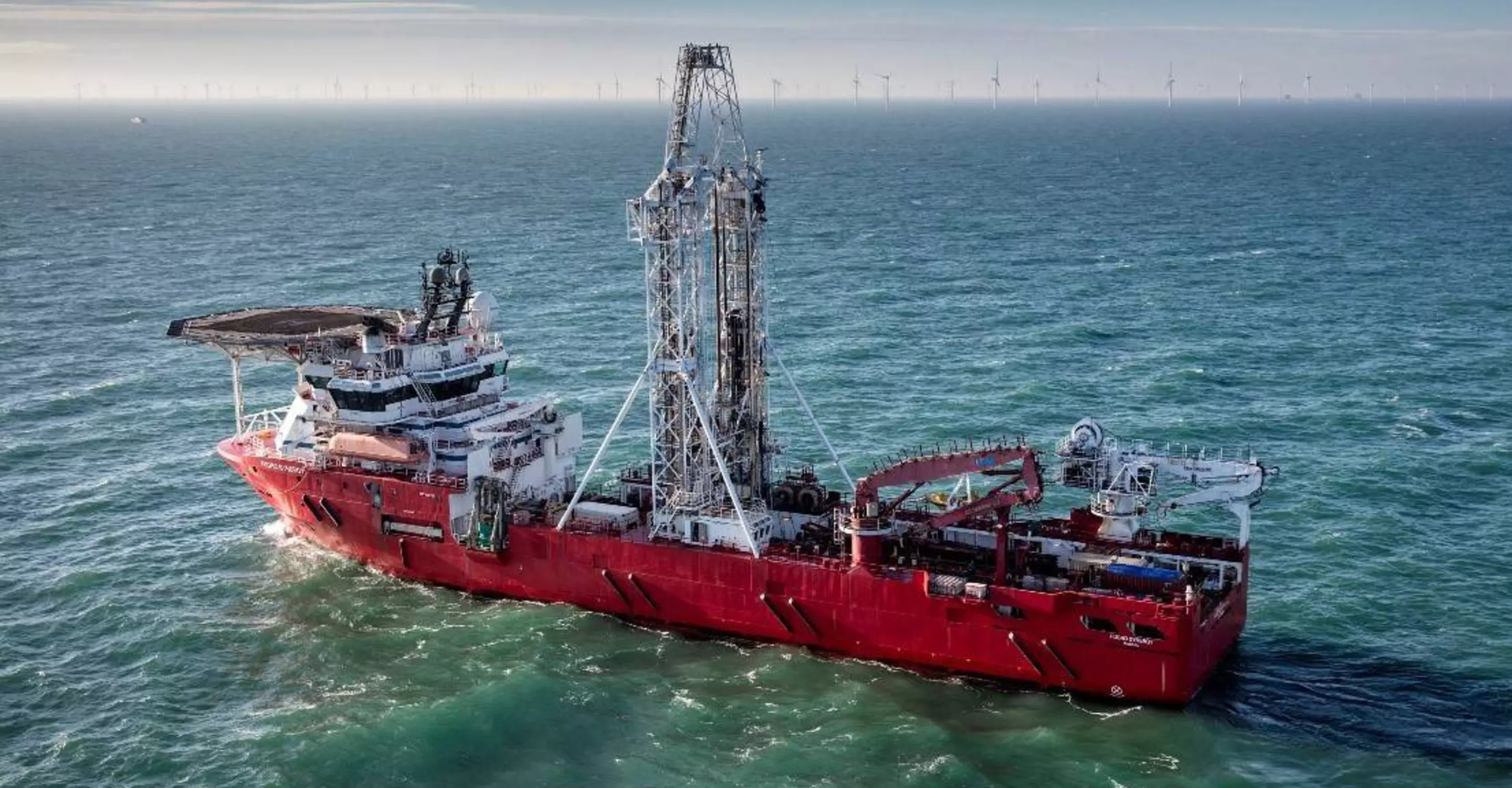
Seacore has successfully used a combination of reverse circulation drilling and vibratory pile driving techniques, in conjunction with novel and versatile pile handling equipment, to install several weeks ahead of programme, tubular steel monopiles in extremely variable sea bed conditions at the Swedish Port of Gothenburg.
The monopiles - founded in a mixture of soft silty clay to very hard granite - support 10m long cantilevered gantries and beacons to identify the Port's northern Torshamnsleden and southern Böttöleden navigation access channels through the offshore archipelago.
The monopiles and new marker lights are part of SEK 500M project by the Swedish Maritime Administration, to improve and increase safety and capacity of the access channels and port entrance, to comply with international safety standards. The port, which is at the mouth of the deep and wide river Göta, is the largest in the Nordic region and is the main hub for transferring cargo between large trans-world vessels and the smaller ships in the Baltic.
The vast port improvement scheme, which started at the beginning of 2003, also included dredging about 11Mm3 of clay and drilling and blasting 0.5Mm3 of rock from the channels and port entrance. Böttöleden, which is 6km long and relatively straight and wide, was not deep enough for vessels with a draught exceeding 10m. The main Torshamnsleden channel is 10 km long and deep enough for Panamax ships, but it is narrow and with a tight bend has been difficult to navigate. Seacore, operating in up to 25m of water from Deep Diver jack-up platform, provided specialist monopile installation and beacon gantry erection services to main beacon design and build contractor M.T. Højgaard, Denmark's biggest civil engineering contractor. Working around the clock in two 12 hour shifts, Seacore used the T8 reverse circulation drill and a hired PTC 175 vibratory pile driver to install the 3 types of monopiles, ranging from 1.5m - 1.8m diameter.
The Type 1 piles involved drilling a rock socket through little or no overburden and into between 8m and 9m of very hard granite with quartz inclusions. This was done by holding a reusable conductor tube in a pair of special circular, gripping waling gates over the pile location and resting on the seabed. The pile gates, which operate like a pair of mechanical hands, can move independently of each other and are mounted on a frame supported by a pair of cantilevered finger pontoons on the stern of Deep Diver. The Teredo 8 reverse circulation drill rig was gripped on to the top of the conductor and the drill bit lowered down inside to drill the socket in up to 200 MPa compressive strength rock. On completion the drill rig and conductor were removed and the appropriate pile, complete with temporary bungs in each end, was towed out to Deep Diver for the crane to perform a buoyant lift. The pile was gradually flooded until the water levels were equalised and the pile vertical; the lower bung was removed and the pile lowered into the drilled clearance rock socket and plumbed and levelled prior to grouting the annulus between pile wall and hole. An extension piece was flange bolted on by divers to take the pile above sea level and a cantilevered gantry was attached prior to M.T. Højgaard completing the beacon.
The Type 2 piles were installed using a combination of the T8 drill and the PTC 175 vibratory pile driver in a "drive, drill, drive" operation. After towing the pile was positioned and held in the pile gates and lowered into the seabed overburden; a reusable conductor extension tube bolted on and vibrator attached to drive the pile down to rock head. The vibrator was replaced by the T8 drill, cleaning out the overburden inside the pile and drilling an under reaming socket slightly bigger than the pile diameter into the underlying rock. The drill was replaced by the vibrator and the zpile driven to level into the blind hole. Some piles have additional support at the seabed provided by a large circular steel frame resembling a doughnut, which was lowered down the pile by Seacore and filled with ballast and grouted by M. T. Højgaard. The conductor was then removed and replaced with the pile extension and beacon gantry.
The Type 3 piles were pitched and held in the special gates and with a reusable conductor extension, driven with the vibrator to a penetration of up to 24m into the seabed through a mixture of overburden, loose sands and clays. All Type 3 piles were stabilised with the ballasted doughnuts at the seabed. In addition all the project's 34 monopile foundations incorporate a special flange-bolted "weak link" just above seabed level. In the event of the navigation beacons being hit by a vessel they have been designed to snap off, leaving the solid seabed foundation undisturbed. The use of rigid beacons, compared with the traditional marker lights fixed to moving floating buoys and anchored by chains to the seabed, is expected to considerably reduce the amount of dredging of the channels.
"The key to our success on this job has been the versatility of our twin gripper piling gates, which we designed and built at our head office and works in Cornwall," said Seacore project manager Phil Wilkinson. "I don't think we would have been able to install these monopiles in the very hard rock without them. The gates are so versatile and have proved invaluable, especially when drilling the sockets. Some of the rock slopes quite steeply and normally would be difficult to get the hole started as the bit would have a tendency to wander off line. But with the gripper gates we can rigidly hold the conductor or pile to provide a fixed guide for the bit to drill an accurate and vertical socket."
Seacore, which has considerable experience installing monopiles up to 4m diameter, had to compete in open tender for the Gothenburg beacons. "We have very variable seabed conditions here and Seacore's offer was the best technically, on equipment, price and references. It was a very good bid," said M. T. Højgaard’s project manager Lars Forsberg. "Seacore has done an excellent job and had no problems at all. It is a very well run company and very practically minded. We had an excellent relationship on site and they have been very easy to work with and finished the job several weeks ahead of programme. I would have no hesitation in working with them again."